
Embroidery on Performance Polos: What Can Go Wrong
Performance polos look great, but embroidery can cause puckering, distortion, and heavy-looking logos if the setup is wrong. Here’s what to watch for.
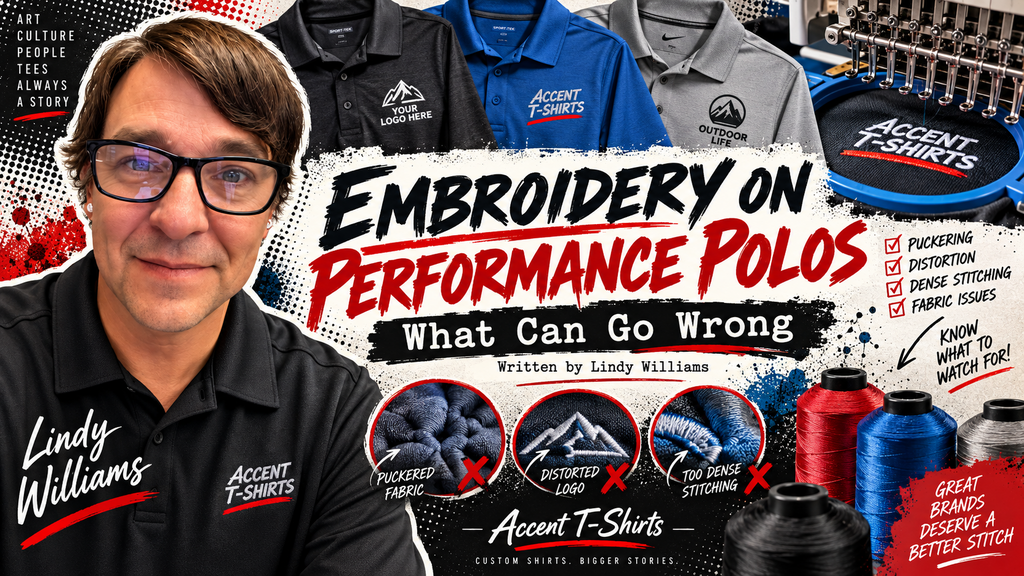
Performance polos are one of the most popular choices for uniforms, golf outings, corporate apparel, trade shows, and staff shirts.
They are lightweight, breathable, moisture-wicking, and usually look a little more polished than a basic T-shirt.
They are also one of the easiest garments to mess up with embroidery.
The problem is simple: embroidery adds weight, tension, and thousands of stitches to a fabric that was designed to be light and flexible.
If the logo is not digitized correctly, the thread is too dense, or the garment is hooped poorly, the finished polo can end up looking worse than it did before the embroidery ever started.
Here are some of the most common problems.
1. Puckering Around the Logo
This is probably the most common issue.
Performance polos are often made from lightweight polyester or polyester blends. Those fabrics can stretch and move much more than a heavy cotton polo.
When a dense embroidery design is stitched onto that lightweight material, the thread can pull the fabric inward.
The result is that wrinkled or puckered look around the logo.
A good embroidery setup has to account for the fabric, not just the artwork.
That may mean adjusting stitch density, underlay, backing, and even the size of the logo.
2. The Logo Is Too Heavy
Not every logo should be embroidered exactly as it appears on a computer screen.
A complicated logo with thick fills, multiple layers, tiny details, and a large footprint can become very heavy once converted into stitches.
On a heavyweight jacket, that may be fine.
On a thin performance polo, it can feel like someone attached a patch to your chest.
Sometimes the best solution is to simplify the design.
Fewer stitches can actually make the logo look cleaner and make the shirt much more comfortable to wear.
3. Small Text Can Disappear
Tiny lettering is another major problem.
Customers often want a company name, tagline, phone number, or department name embroidered under a logo.
On-screen, it may look perfectly readable.
Once converted to thread, those tiny letters can close up, blur together, or become impossible to read.
Thread has thickness.
There is a limit to how small you can go before the letters simply stop working.
In some cases, increasing the text size slightly or changing to a cleaner font makes a huge difference.
4. The Fabric Can Stretch During Sewing
Performance fabric moves.
That sounds obvious, but it matters a lot during embroidery.
If the shirt is stretched too tightly when it is hooped, the fabric may relax after embroidery and cause the design to distort.
If it is not held securely enough, the garment can shift while the machine is sewing.
Either way, the logo may end up slightly warped, crooked, or uneven.
Proper hooping and stabilization are just as important as the digitizing itself.
5. Heat Can Become a Problem
Most performance polos are synthetic.
Synthetic fabrics do not always react well to excessive heat.
While embroidery itself does not use the same high temperatures as some transfer methods, heat can still come into play during finishing, pressing, steaming, or removing certain materials.
Too much heat can cause shine marks, discoloration, or even fabric damage.
That is one reason experienced decorators treat performance apparel differently than traditional cotton garments.
6. The Backing Matters More Than You Think
One of the most important parts of embroidery is something the customer rarely sees.
The backing behind the embroidery helps keep the fabric stable during sewing.
On a performance polo, the wrong backing can create problems.
Too little support may lead to puckering.
Too much backing can make the shirt stiff and uncomfortable.
The goal is to use enough stabilization to support the design without turning a lightweight polo into body armor.
7. Not Every Performance Polo Embroiders the Same
Two polos can both be labeled “100% polyester” and behave completely differently.
One may be thick and structured.
Another may be extremely lightweight and stretchy.
Some have textured weaves.
Others are very smooth.
Some have mesh panels or ventilation zones that should never be embroidered through.
That means the same exact logo may need different settings depending on the garment.
This is why testing matters.
8. Placement Can Be Tricky
Left-chest embroidery sounds simple, but performance polos often have design features that complicate things.
Seams, plackets, pockets, ventilation panels, and athletic cuts can all affect where the logo should sit.
A logo that is placed too close to the center may look awkward.
Too far toward the sleeve and it can disappear around the side of the body.
Good placement should look natural when the shirt is actually being worn, not just when it is lying flat on a table.
9. Thread Color Can Behave Differently on Polyester
Thread color can also change visually depending on the shirt color and fabric finish.
A bright white thread may look slightly different against a shiny polyester polo than it does against cotton.
Dark fabrics can also make certain thread colors appear more muted.
Brand colors should always be matched as closely as possible, but embroidery thread is not the same thing as digital color or Pantone ink.
There will always be some variation.
10. Sometimes Embroidery Is Not the Best Choice
This is probably the most important point.
Just because something can be embroidered does not mean it should be.
If a performance polo is extremely thin and the logo is large, detailed, or very dense, another decoration method may actually produce a better result.
A good decorator should be willing to say that.
The goal is not simply to put embroidery on the shirt.
The goal is to make the finished garment look good.
The Bottom Line
Performance polos are great garments, but they require a little more thought when embroidery is involved.
The fabric is lighter.
The construction is different.
The material stretches.
And the logo has to be digitized with all of that in mind.
When everything is set up correctly, embroidered performance polos can look extremely clean and professional.
When it is not, you end up with puckering, distortion, heavy logos, and unhappy customers.
At Accent T-Shirts, we look at the garment, the artwork, the stitch count, and the intended use before production begins.
Sometimes the best embroidery job is not the one with the most stitches.
It is the one that looks like it was always supposed to be there.
Lindy Williams
Accent T-Shirts
702-866-8888
AccentTShirts.com
WRITTEN BY LINDY WILLIAMS