
Las Vegas Embroidery: How Quality Needles Improve Stitching | Accent T-Shirts
Learn why needle quality matters in Las Vegas embroidery—fewer thread breaks, cleaner details, and longer-lasting stitches. Tips from Accent T-Shirts.
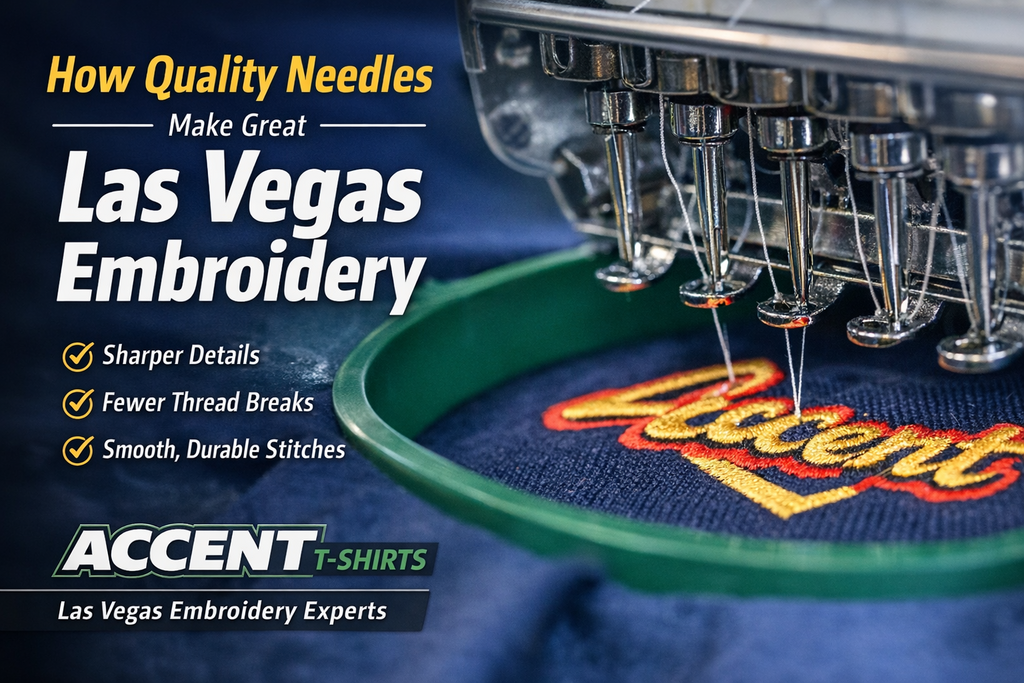
If you’ve ever picked up an embroidered hat or polo and thought, “Wow, that looks clean,” there’s a good chance the difference came down to something most people never notice: the needle.
In the world of Las Vegas embroidery, customers usually focus on thread colors, logo size, and placement (left chest, hat front, sleeve). Those matter—big time. But behind the scenes, the needle is the tool doing the real work: punching through fabric thousands of times, guiding thread into place, and shaping the final look and durability of your stitchout.
At Accent T-Shirts, we’ve seen it all: perfect embroidery on a tricky fabric because the needle choice was right—and the opposite, where a design that should look great starts showing thread breaks, fuzzy edges, or puckering because the needle wasn’t ideal for the garment.
This guide is for anyone building a stronger embroidery program: business owners ordering uniforms, brand managers, event coordinators, and anyone who wants better results from their Las Vegas embroidery shop. We’re going deep into why needles matter, how they affect quality, what needle types work best on common garments, and how we choose needles to keep your embroidery clean and consistent.
Why the Needle Matters in Las Vegas Embroidery
Embroidery is controlled impact. An embroidery machine needle moves up and down at high speed, piercing fabric repeatedly to form stitches. That piercing does three things every single stitch:
- Opens a path through the fabric
- Carries the thread through consistently
- Determines how the thread sits on top of the garment
When the needle is the right type and size for the fabric, the result is smooth, readable, and durable embroidery. When it’s wrong, you may see:
- Thread breaks (especially on dense logos)
- Skipped stitches
- Fraying or fuzzy edges
- Puckering and distortion
- Holes in fabric or torn fibers
- Uneven satin columns
- Poor small text legibility
That’s why needle selection is a big part of professional Las Vegas embroidery work—especially when you’re stitching logos on different garment types like polos, hats, beanies, jackets, and performance fabrics.
The Basics: How an Embroidery Needle Actually Works
An embroidery needle isn’t just a pointy piece of metal. It’s engineered with specific features that influence stitch quality:
- Point type (sharp, ballpoint, etc.)
- Diameter/size (bigger or smaller needle)
- Eye shape/size (how thread passes through)
- Scarf (a cut-out that helps the hook catch thread properly)
- Groove (guides thread so it doesn’t rub and fray)
At machine speeds, a tiny difference in needle point or size can be the difference between a flawless stitchout and a production nightmare.
Needle Point Types: The Hidden Secret Behind Clean Stitching
1) Sharp/Standard Point Needles
A sharp point needle pierces cleanly through woven fabrics and stable garments.
Best for:
- Woven button-ups
- Denim
- Canvas bags
- Structured jackets
- Some thick workwear
What it does well:
- Cuts through dense, stable fabric cleanly
- Helps prevent “pushing” fabric fibers around
What can go wrong:
On knits (like polos and tees), sharp points can cut fibers and lead to runs or damage. For knit garments, ballpoint styles are often better.
2) Ballpoint Needles (Light Ballpoint)
Ballpoints don’t “cut” through fabric fibers as aggressively. They push between fibers, which is ideal for knit materials.
Best for:
- Polo shirts
- T-shirts
- Knit caps and beanies (depending on knit type)
- Many uniform shirts
What it does well:
- Reduces fabric damage
- Helps embroidery sit smoother on knits
- Lowers risk of cutting fibers that lead to wear
3) Medium/Heavy Ballpoint Needles
These are designed for thicker knits or stretchier fabric.
Best for:
- Thick knits
- Sweatshirts
- Some performance apparel
- Sweater-style fabric
What it does well:
- Prevents cutting into knit fibers
- Helps reduce skipped stitches in stretchy materials
Common issue if wrong:
If the ballpoint is too heavy for the fabric, stitches can become less crisp, especially on fine detail.
4) Specialty Points (Like “SES” / “SPI” styles in embroidery)
Different manufacturers label these differently, but in practice they’re variations that optimize for thread protection or fabric behavior.
Best for:
- High-speed production
- Tricky fabric + dense designs
- Smooth thread flow with fewer breaks
In a busy Las Vegas embroidery production environment, these “small improvements” are what keep your order consistent from piece 1 to piece 200.
Needle Size: Why “One Size Fits All” Doesn’t Work
Needle size affects:
- How large the hole is in the fabric
- How well the needle carries the thread
- How much friction the thread experiences
- How crisp your details can be
A needle that’s too small can cause:
- Thread breaks (thread can’t pass smoothly)
- Fraying or shredding
- Heat buildup
A needle that’s too large can cause:
- Visible holes
- Distorted fabric
- “Wiggle” in detail areas
- Rough-looking fills
Common Embroidery Needle Sizes (General Guidance)
(Names vary by brand, but these are typical.)
- 75/11: Fine details, lighter fabrics, smaller text
- 80/12: A common all-around needle for many garments
- 90/14: Thicker fabrics, jackets, hats, heavier stitching
For many logo jobs on polos in our Las Vegas embroidery shop, an 80/12 with the right point style is a reliable go-to. But hats, heavy jackets, or super dense designs may push toward a different size.
The Real-World Impact: What Great Needles Fix (and Prevent)
1) Cleaner Small Text and Sharper Edges
Small lettering is one of the hardest things in embroidery. If the needle is too large, it can “blow out” small satin columns—making text look thick, uneven, or unreadable.
A proper needle size and point can:
- Keep columns tighter
- Prevent distortion
- Help stitches lay cleaner
If your brand needs small “tagline” text under a logo, needle choice matters as much as digitizing.
2) Fewer Thread Breaks = Better Consistency
Thread breaks kill consistency. Every time the machine stops, you risk:
- A visible thread start/stop point
- Slight tension differences
- Micro shifts that show in tight detail
With the right needle:
- Thread passes smoother through the eye
- Friction is reduced
- Breaks become far less common
On larger jobs (uniform programs, school spiritwear, event apparel), fewer breaks means your whole run stays consistent—exactly what you want from Las Vegas embroidery production.
3) Less Puckering on Polos and Performance Wear
Puckering often happens when stitches pull fabric too tightly or when the fabric is damaged/stressed by the needle.
The right needle helps by:
- Piercing correctly for the fabric type
- Minimizing fiber damage
- Letting stitches settle naturally
Pair that with proper backing and tension, and your left-chest logo on a polo sits flatter and cleaner.
4) Better Results on Hats (Where Everything is Harder)
Hats are stiff, curved, and structured. They’re also one of the most popular items in Las Vegas embroidery.
Needle choice on hats affects:
- Penetration through structure
- Thread breaks on dense areas
- Clean satin columns and borders
A hat logo needs both good digitizing and the right needle to punch cleanly without causing excessive thread shredding.
Needle + Thread + Fabric: It’s a System
A needle doesn’t work alone. In embroidery, quality comes from a system:
- Digitizing (stitch type, density, pull compensation)
- Needle (point and size)
- Thread (weight, quality, type)
- Backing (cutaway/tearaway/washaway)
- Tension (top and bobbin)
- Hooping (stability and alignment)
A “perfect” digitized file can still stitch poorly if the needle doesn’t match the fabric and thread.
That’s why a professional Las Vegas embroidery shop doesn’t just run one setup for everything—especially when you’re doing mixed orders (polos + hats + jackets).
Common Garment Types in Las Vegas Embroidery (And Needle Considerations)
Embroidered Polos (Corporate Apparel)
Polos are usually knit, sometimes with stretch.
Needle considerations:
- Ballpoint often reduces fiber damage
- Proper size helps keep small details readable
- Great for left chest logos and name personalization
Common issues to prevent:
- Puckering
- Distortion around the chest area
- Unreadable text
Embroidered Hats (Trucker Hats, Snapbacks, Dad Hats)
Hats vary a ton: foam fronts, structured twill, unstructured cotton.
Needle considerations:
- Strong penetration for structured materials
- Needle eye and thread flow matter (break prevention)
- Consistent stitch formation is critical
Common issues to prevent:
- Thread shredding
- Gaps in columns
- Distorted outlines
Embroidered Jackets and Outerwear
Outerwear can be thick (softshells, fleece, work jackets).
Needle considerations:
- Larger needle size often helps with penetration and thread protection
- Point selection matters depending on woven vs fleece pile
Common issues to prevent:
- Loops on fleece
- Uneven fills
- Poor adhesion of stitches to thick fabric
Performance Fabrics (Poly, Stretch, Athletic Wear)
Performance wear can be slippery, thin, and stretch.
Needle considerations:
- Needle must minimize damage to fabric
- Proper backing is essential
- Great needle choice helps reduce puckering and “warping”
Bags, Canvas, Denim
These are more stable materials.
Needle considerations:
- Often tolerate sharp points better than knits
- Needle strength + size matters for thick material
- Great for strong, bold logos
Signs Your Embroidery Needle Isn’t Right
If you’re ordering embroidery and you see these issues, it’s often a needle mismatch—or a worn needle:
- Frequent thread breaks
- Stitching looks fuzzy or “hairy”
Holes around the logo
- Fabric looks chewed up
- Satin stitches look uneven
- Stitches are skipping
- Design shifts or becomes inconsistent
- Small text becomes unreadable
- In a good
- Las Vegas embroidery setup, needle changes are routine. Worn needles are a top cause of quality problems.
How Often Should Needles Be Changed?
In professional production, needles are not “set it and forget it.” They wear out because of:
- High speed and friction
- Dense stitching
- Tough fabrics
- Adhesives on backing
- Metallic threads (especially abrasive)
Many embroidery shops change needles on a schedule (per number of stitches or per run) rather than waiting for problems.
That’s part of what you’re paying for with a quality Las Vegas embroidery shop: proactive quality control, not reactive troubleshooting.
Why Cheap Needles Can Cost You More
It’s tempting to think a needle is a needle. But needle quality affects:
- Consistency of size and finish
- Smoothness of the eye and groove (thread protection)
- Longevity (how long it stays sharp/true)
- Risk of burrs that shred thread
Cheap needles can cause more:
- Thread breaks
- Machine stops
- Visible defects
- Re-runs and wasted garments
If you’re a business ordering uniforms, you don’t want “cheap needle results.” You want clean embroidery that represents your brand.
What We Do at Accent T-Shirts (Las Vegas Embroidery Quality Approach)
When we run embroidery jobs in Las Vegas, we look at:
- Garment type (knit polo vs structured hat vs fleece)
- Logo detail (tiny text vs bold shapes)
- Stitch density (light fill vs heavy satin and fill)
- Thread type (standard vs specialty)
- Backing (tearaway vs cutaway)
- Needle point and size that matches the above
That’s how we keep your embroidery consistent, readable, and durable.
Practical Tips If You’re Ordering Embroidery in Las Vegas
If you want the cleanest result from any Las Vegas embroidery shop, here’s what helps:
1) Tell the shop what the garment is made of
Cotton polo, poly performance, fleece jacket, structured hat—needle choice changes.
2) Avoid tiny text when possible
Small text is doable, but it requires proper digitizing and careful production settings. If it must be tiny, ask for a proof and be open to minor adjustments.
3) Provide the best artwork you can
Vector files help. But even if you only have a PNG, a good shop can advise what’s realistic and create a stitch-ready setup.
4) Ask about test stitchouts for critical logos
If you’re rolling out uniforms for a whole staff, a sample stitchout can save headaches.
FAQ: Needles and Embroidery Quality
Do needles really make that big a difference?
Yes. Needle point and size affect thread breaks, detail sharpness, puckering, and fabric damage—especially on polos and hats.
Why does my embroidered logo look “fuzzy”?
It can be a worn needle, incorrect needle type, thread tension, or digitizing density. A quality shop will troubleshoot all of these.
Is embroidery always better than printing?
Not always. Embroidery is premium for logos and uniforms. Printing is often better for large, colorful artwork on t-shirts. Many customers use both.
Can embroidery damage fabric?
It can if the needle and settings aren’t right—especially on knits and performance fabric. Proper needle choice helps prevent that.
Conclusion: Great Needles = Great Las Vegas Embroidery
When embroidery looks perfect—crisp edges, smooth fills, readable text, and no puckering—it’s rarely an accident. It’s the result of good digitizing, stable hooping, quality thread… and the right needle choice.
That’s why, at Accent T-Shirts, needle selection is part of the quality process—not an afterthought. Whether you’re ordering embroidered polos for a corporate team, hats for a brand drop, jackets for a crew, or uniforms for staff, the needle choice behind the scenes helps your finished product look premium and last longer.
If you’re searching for Las Vegas embroidery and you want results that look clean, consistent, and professional—send us your logo and what you’re decorating. We’ll recommend the best approach for your items and your timeline.
Ready to get started?
Request a quote at AccentTShirts.com or call 702-866-8888.