
Why Fabric Is Everything: The Unsung Hero of Custom T-Shirt Embroidery
By Lindy Williams, Founder of Accent T-Shirts
When people walk through the doors of our shop here in Las Vegas, they almost always arrive with a vision in mind. They hold up a USB flash drive or point to a phone screen, showing off a crisp, high-resolution graphic. They talk thread colors, design placement, and stitch counts.
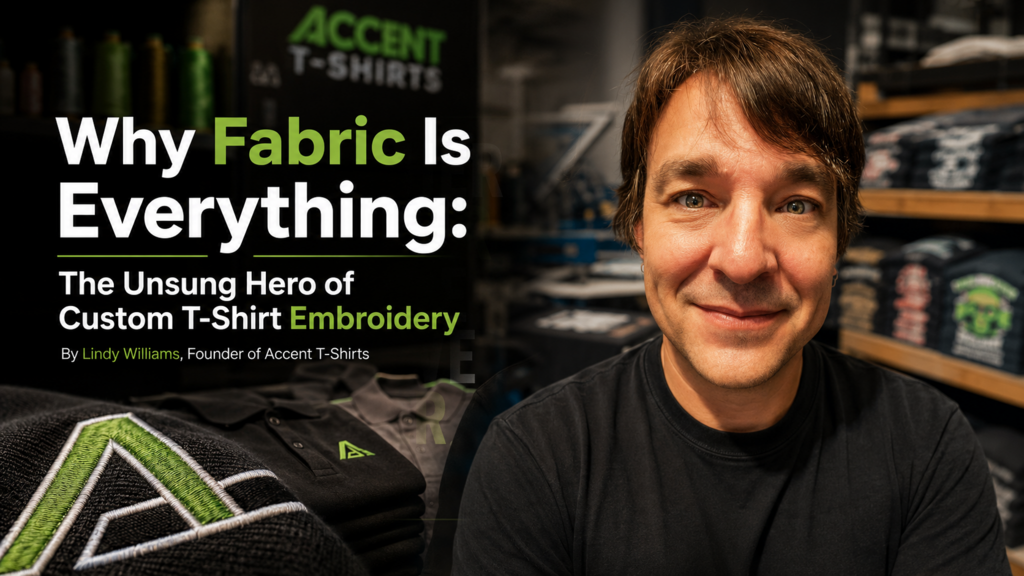
Why Fabric Is Everything: The Unsung Hero of Custom T-Shirt Embroidery
By Lindy Williams, Founder of Accent T-Shirts
When people walk through the doors of our shop here in Las Vegas, they almost always arrive with a vision in mind. They hold up a USB flash drive or point to a phone screen, showing off a crisp, high-resolution graphic. They talk thread colors, design placement, and stitch counts.
And I love that energy. Custom apparel isn't just clothing; it’s a canvas for your brand, your event, or your lifestyle. But after nearly three decades in the commercial decoration business, I’m going to share a secret that separates a dynamic, professional embroidered t-shirt from one that ends up crumpled at the bottom of a drawer: It all begins with the fabric.
In embroidery, fabric isn't just the backdrop. It’s the structural foundation holding thousands of high-speed needle penetrations together. If you choose the wrong garment, even the most skilled digitizer and the state-of-the-art embroidery machine can't save your design.
Let’s break down why fabric selection is the single most important decision in the embroidery process for accent t-shirts—and how to get it right every single time.
1. The Physics of Embroidery: Threads vs. Knits
To understand why fabric matters so much, you have to look at what machine embroidery actually does to a t-shirt.
A standard t-shirt is made of knit fabric. Knits are created by looping yarns together, giving the shirt its stretch, flexibility, and comfortable drape. Embroidery, on the other hand, involves anchoring thousands of high-density rayon or polyester threads into that flexible matrix.
When an embroidery needle punches through a t-shirt 800 times a minute, it exerts physical tension. If the fabric lacks sufficient weight or structural integrity, two main issues crop up:
- Puckering: The heavy stitches pull the loose knit fibers inward, creating wave-like ripples around your design that no iron can fix.
- Garment Distortion: The sheer weight of the embroidered crest pulls down on the chest or sleeve, causing the t-shirt to sag awkwardly on the wearer.
- Heavy woven materials like canvas jackets, denim, or thick polo shirts easily absorb needle tension. T-shirts, however, require a careful balance between shirt weight, knit density, and embroidery stabilization.
2. Decoding T-Shirt Fabrics for Custom Stitching
Not all t-shirt fabrics respond to needle and thread the same way. When client projects call for embroidered accents—like left-chest crests, sleeve hits, or hem tags—these are the primary fabrics we evaluate:
Heavyweight 100% Ring-Spun Cotton (6.0 oz/yd² and up)
- The Verdict: The absolute gold standard for t-shirt embroidery.
- Why It Works: Heavyweight ring-spun cotton features tightly spun fibers woven into a dense, stable grid. The fabric offers enough body to hold medium-to-dense stitch counts with minimal distortion. It delivers a rich, textured contrast against polished embroidery thread.
Light-to-Midweight Combed Cotton (4.2 – 5.3 oz/yd²)
- The Verdict: Excellent for retail apparel, provided the embroidery design is adjusted.
- Why It Works: Combed cotton is ultra-soft and comfortable. However, because it’s lighter and softer, it requires lightweight, open-weave embroidery designs or minimalist text. Heavy bullet logos on a thin 4.2 oz tee will cause sagging.
Tri-Blends (Cotton/Poly/Rayon) & Performance Knits
- The Verdict: Requires extreme precision and specialist stabilization.
- Why It Works: Tri-blends are legendary for their buttery-soft hand-feel, but their inherent stretch makes them tricky. High-elastane performance gear presents similar challenges. Stretchy fabrics pull easily under thread tension. To embroider tri-blends successfully, shops must use ballpoint needles (which slide between fibers rather than piercing them) alongside specialty mesh backings that stretch with the shirt without distorting the design.
3. The Trinity of Embroidery Success: Fabric, Backing, & Digitizing
In the shop, we treat embroidery like a tripod. If one leg collapses, the whole project fails. The three legs are Fabric, Stabilizer (Backing), and Digitizing.
             ┌─────────────────────────┐
             │     FABRIC SELECTION    │
             │ (Weight, Fiber, Stretch)│
             └────────────┬────────────┘
                          │
            ┌─────────────┴─────────────┐
            │                           │
┌───────────┴───────────┐   ┌───────────┴───────────┐
│  STABILIZER BACKING   │   │  CUSTOM DIGITIZING    │
│ (Cutaway vs. Tearaway)│   │ (Density & Push/Pull) │
└───────────────────────┘   └───────────────────────┘
When you choose your fabric, it directly dictates how we execute the other two legs:
Stabilizer Backing Selection
Backing is the unseen material hooped behind the shirt to give it temporary or permanent structure.
- Tearaway Backing: Best for heavy, stable materials like hats or canvas bags.
- Cutaway Backing: Essential for t-shirts. Because knits stretch, the backing must remain behind the stitches for the life of the shirt to prevent the embroidery from warp-stretching in the wash. For lighter tees, we use soft "no-show" mesh cutaway so the backing feels comfortable against the skin without showing through light fabrics.
Custom Digitizing Adjustments
Digitizing isn't just converting a PNG into a stitch file—it’s programming physics. When digitizing for a flexible t-shirt fabric, we program push-and-pull compensation. Fabrics expand and contract differently under needle strike depending on their blend. A design digitized for a structured jacket will ruin a soft cotton tee. The stitch file must be mapped specifically to your shirt's fabric properties.
4. Pro Tips for Planning Your Next Embroidered Accent Tee
If you're launching a streetwear brand, updating corporate uniforms, or designing high-end merch, keep these practical tips in mind before placing your apparel order:
- Match Design Scale to Garment Weight: Keep embroidered t-shirt accents targeted and clean. Monograms, small chest crests, sleeve hits, and back-neck placements work beautifully. Save full-back coverage designs for screen printing or outerwear.
- Prioritize Ring-Spun over Open-End Cotton: Ring-spun cotton fibers are continuously twisted and thinned, creating a smooth, flat surface. Open-end cotton can be fuzzy, which allows tiny stitches to sink in and disappear.
- Don't Rush the Proofing Stage: Always review a sew-out sample on the actual garment fabric you intend to use—not a scrap piece of felt. How the thread interacts with your specific fabric color, drape, and texture makes all the difference.
Crafting Garments That Last
A t-shirt should never feel like a throwaway item. When you combine high-quality fabric with precision embroidery, you create a piece of clothing people want to wear year after year.
At the end of the day, decorated apparel is equal parts art and engineering. Respecting the relationship between needle, thread, and fabric is how we turn simple blank tees into polished, high-end branded apparel. Before you focus solely on thread colors or logo size, start with the garment itself—get the foundation right, and the craft will shine through every stitch.

Written by Lindy Williams, Founder of Accent T-Shirts
Lindy Williams is the founder and owner of Accent T-Shirts in Las Vegas, Nevada, a custom apparel and promotional products company he started in 1999. With more than 25 years of hands-on experience in screen printing, embroidery, custom apparel, branded merchandise, and promotional products, Lindy has worked with everyone from local businesses and schools to large corporate and event clients. His approach to business is simple: be honest, communicate clearly, do quality work, and build relationships that last longer than a single order. In addition to running Accent T-Shirts and Race Day Outfitters, Lindy is also a musician, songwriter, and creative entrepreneur who has spent much of his life building businesses, making music, and turning ideas into something real.